DNR Fish Survey Results
User Survey · Wisconsin DNR · presented August 26, 2026 · slides 16–24 (PDF)
Aquatic habitat
How has the aquatic habitat within Squirrel Lake changed since you have been on Squirrel Lake?
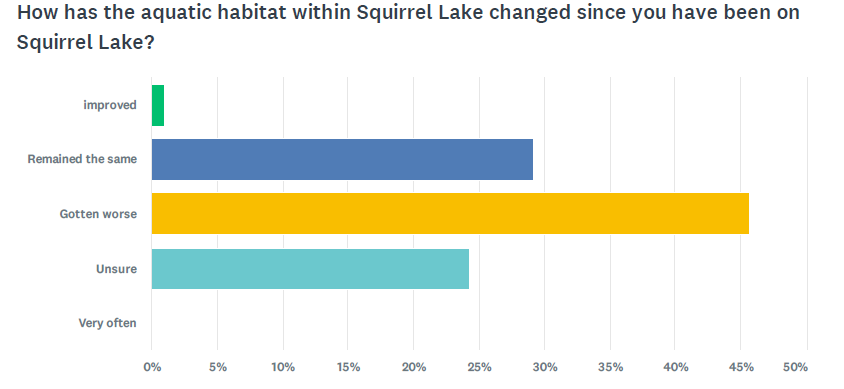
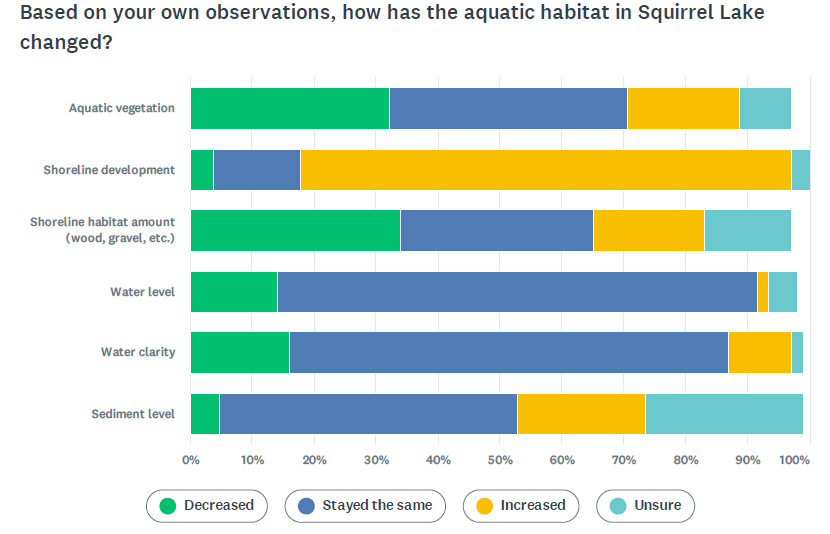
Habitat changes
Based on your own observations, how has the aquatic habitat in Squirrel Lake changed?
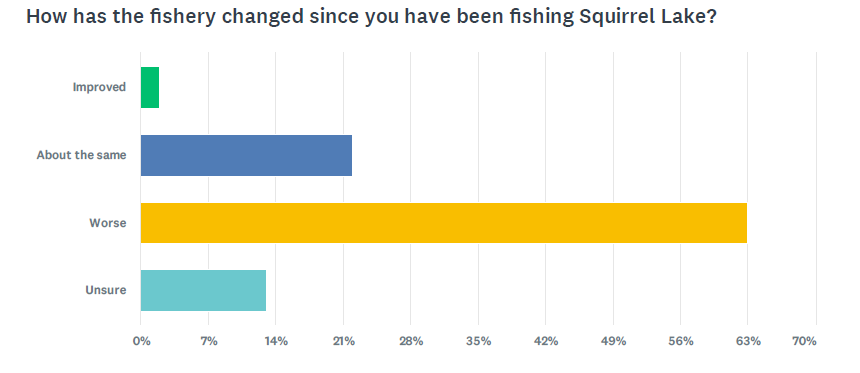
Change in the fishery
How has the fishery changed since you have been fishing Squirrel Lake?
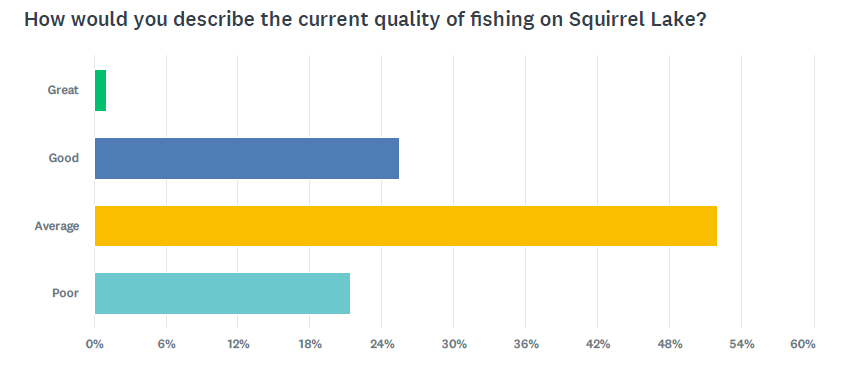
Quality of fishing
How would you describe the current quality of fishing on Squirrel Lake?
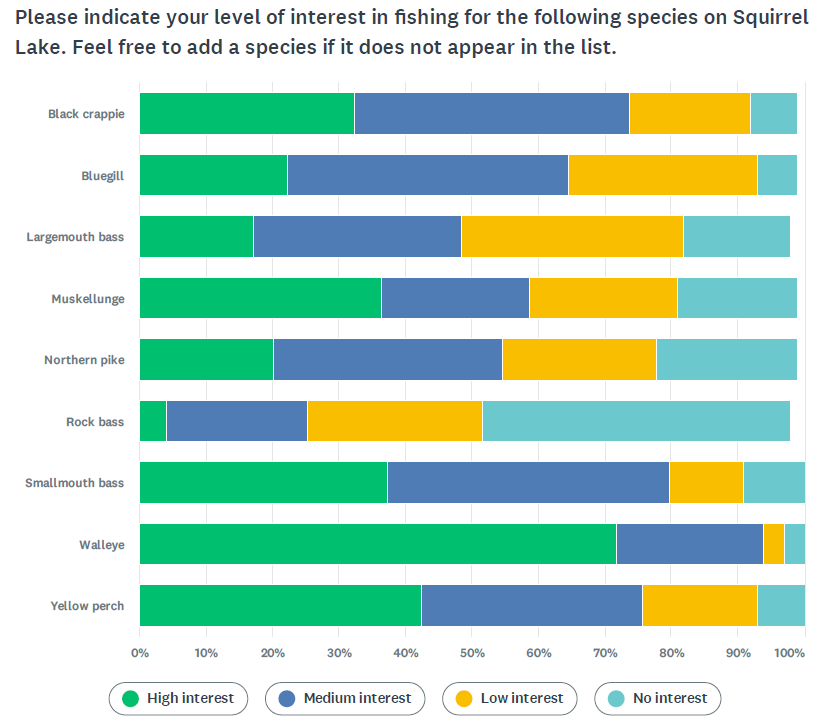
Interest by species
Please indicate your level of interest in fishing for the following species on Squirrel Lake. Feel free to add a species if it does not appear in the list.
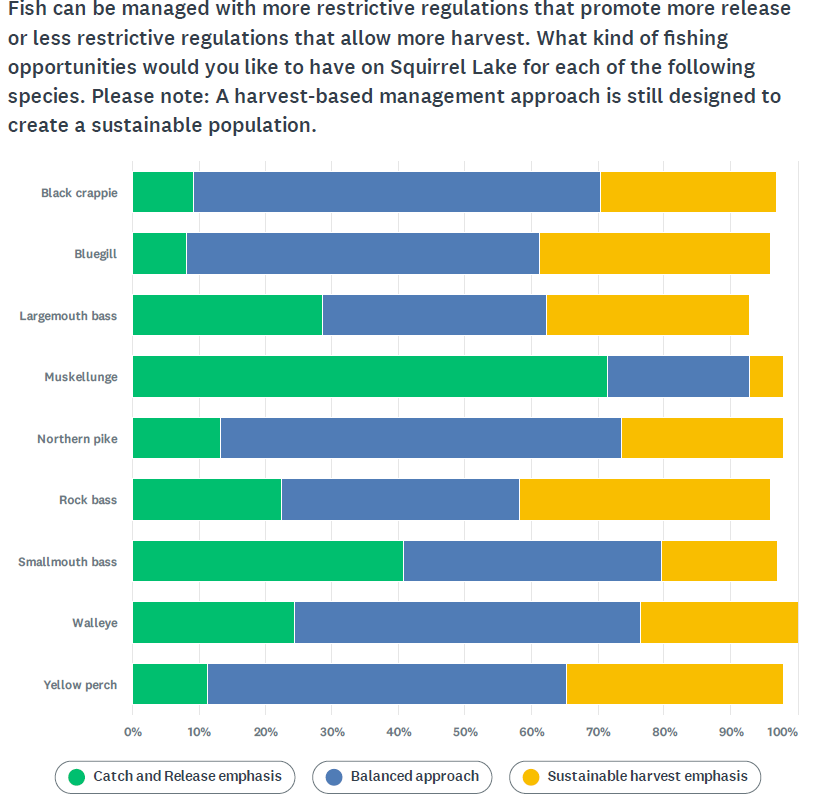
Management by species
Fish can be managed with more restrictive regulations that promote more release or less restrictive regulations that allow more harvest. What kind of fishing opportunities would you like to have on Squirrel Lake for each of the following species. Please note: A harvest-based management approach is still designed to create a sustainable population.
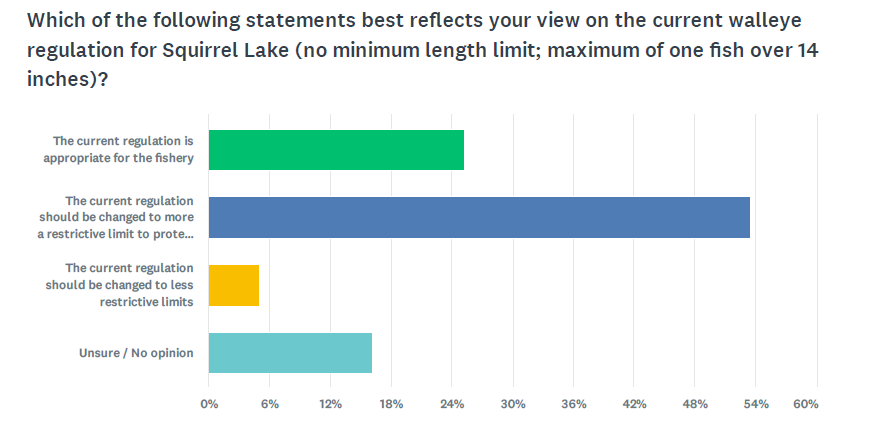
Walleye regulation
Which of the following statements best reflects your view on the current walleye regulation for Squirrel Lake (no minimum length limit; maximum of one fish over 14 inches)?
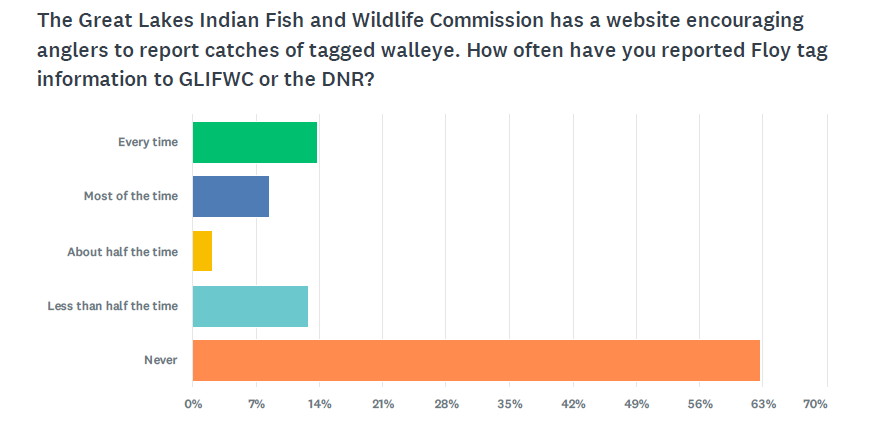
Reporting tagged fish
The Great Lakes Indian Fish and Wildlife Commission has a website encouraging anglers to report catches of tagged walleye. How often have you reported Floy tag information to GLIFWC or the DNR?
Source: Wisconsin DNR, August 26, 2026
Fish Population and Creel Surveys
| Species | Result | Year/Date | Survey | Source |
|---|---|---|---|---|
Muskellunge |
32 total net nights; Total Catch: 43 muskellunge; Size Range: low 20-inch range up to 48 inches; Catch Rate: 1.3 fish per net night |
Began April 27, 2026; as of May 1, 2026 |
Muskellunge survey, netting |
|
Largemouth bass |
0.53 LMB per acre; ~695 fish; 27.04% CV |
Year not stated (presented August 26, 2026) |
Bass Population Estimate (GLIFWC) |
|
Smallmouth bass |
0.19 SMB per acre; ~254 fish; 29.81% CV |
Year not stated (presented August 26, 2026) |
Bass Population Estimate (GLIFWC) |
|
Walleye |
3.29 adults/acre; median length 13" |
2025 |
Adult population estimate (GLIFWC) |
|
All species |
Total angler hours 25,836; 19.6 hours/acre; 526 angler party interviews; catch and harvest by species |
May 6, 2023 – March 3, 2024 |
Creel survey (Wisconsin DNR) |
|
Walleye |
Angler harvest 1,434; tribal harvest 377; total harvest 1,811; angler exploitation 0.0956; tribal exploitation 0.0952; total exploitation 0.1908 |
2023-24 season |
Angler and tribal harvest and exploitation (Wisconsin DNR) |
|
Walleye |
Adult PE 3,962; 3.01 adults per acre |
Spring 2023 |
Adult population estimate (GLIFWC), listed by Wisconsin DNR |
|
Walleye |
Age 0 CPE 66.3 per mile; Age 1 CPE 21.7 per mile |
September 30, 2020 |
Fall walleye recruitment survey (GLIFWC) |
Source: Musky Survey Results – 2026
Source: Wisconsin DNR, Squirrel Lake Group Meeting, August 26, 2026, slide 14 "Bass Population Estimate Results" (the slide gives no survey year)
Source: GLIFWC, Tribal Harvest Management and Status of Squirrel Lake Walleye Fishery, June 17, 2026, slide 31 "Squirrel Lake Walleye Size Structure, 2017-2025"
Source: Wisconsin DNR, Squirrel Lake 2023-2024 Creel Survey Report, Oneida County, Table 1
Source: Wisconsin DNR, 2023-2024 Ceded Territory Fishery Assessment Report, Appendix A, Appendix C and Appendix F-2
Source: GLIFWC, Fish Population Assessments of Ceded Territory Lakes in Wisconsin, Michigan, and Minnesota During 2020, Table B2
Abbreviations
| Abbreviation | As written in the source | Source |
|---|---|---|
CPE |
"catch per effort (CPE)" |
|
CV |
"coefficient of variation" |
|
LMB |
"Largemouth Bass" (heading over "0.53 LMB per acre") |
Wisconsin DNR, August 26, 2026, slide 14 |
PE |
"population estimates (PE)" |
|
PSD |
"proportional stock density (PSD)"; "quality (PSD, ≥15”)" |
|
RSD |
"relative stock density (RSD)"; "preferred (RSD, ≥18”)" |
|
SMB |
"Smallmouth Bass" (heading over "0.19 SMB per acre") |
Wisconsin DNR, August 26, 2026, slide 14 |
YOY |
"young-of-year (YOY)" |
Creel surveys, 2023-24 and 2018-19
Table 2. Comparison of creel survey synopses, Squirrel Lake, 2023-24 and 2018-19 fishing seasons.
CREEL YEAR: 2023-24
| Species | Directed effort (hours) | Percent of total | Total catch | Specific catch rate (hrs/fish) | Total harvest | Specific harvest rate (hrs/fish) | Mean length of harvested fish (inches) |
|---|---|---|---|---|---|---|---|
| Walleye | 7,751 | 19.5% | 4,024 | 2.2 | 1,434 | 5.6 | 13.4 |
| Northern Pike | 2,338 | 5.9% | 1,846 | 3.9 | 329 | 12.0 | 22.7 |
| Muskellunge | 6,211 | 15.6% | 153 | 46.5 | 0 | * | ** |
| Smallmouth Bass | 6,899 | 17.3% | 7,056 | 1.0 | 26 | 338.3 | 16.4 |
| Largemouth Bass | 4,173 | 10.5% | 1,834 | 2.8 | 48 | * | 15.7 |
| Yellow Perch | 4,006 | 10.1% | 11,184 | 0.5 | 3,568 | 1.2 | 8.0 |
| Bluegill | 3,188 | 8.0% | 7,449 | 0.5 | 2,307 | 1.4 | 7.2 |
| Black Crappie | 4,014 | 10.1% | 4,125 | 1.0 | 1,690 | 2.4 | 10.5 |
| Pumpkinseed | 1,148 | 2.9% | 1,028 | 1.4 | 165 | 7.3 | 6.8 |
| Rock Bass | 97 | 0.2% | 448 | 4.7 | 51 | 9.5 | 8.4 |
CREEL YEAR: 2018-19
| Species | Directed effort (hours) | Percent of total | Total catch | Specific catch rate (hrs/fish) | Total harvest | Specific harvest rate (hrs/fish) | Mean length of harvested fish (inches) |
|---|---|---|---|---|---|---|---|
| Walleye | 8,907 | 20.8% | 4,974 | 1.9 | 1,870 | 4.9 | 13.2 |
| Northern Pike | 3,562 | 8.3% | 4,358 | 1.9 | 648 | 6.7 | 22.5 |
| Muskellunge | 7,279 | 17.0% | 241 | 36.9 | 0 | * | ** |
| Smallmouth Bass | 6,671 | 15.6% | 5,077 | 1.5 | 28 | 357.1 | 16.8 |
| Largemouth Bass | 5,116 | 12.0% | 4,185 | 1.4 | 124 | 76.3 | 15.3 |
| Yellow Perch | 4,199 | 9.8% | 9,306 | 0.5 | 1,563 | 2.8 | 8.6 |
| Bluegill | 4,159 | 9.7% | 3,721 | 1.2 | 1,314 | 3.4 | 7.6 |
| Black Crappie | 2,523 | 5.9% | 1,690 | 1.6 | 1,054 | 2.5 | 10.9 |
| Pumpkinseed | 352 | 0.8% | 107 | 3.7 | 67 | 5.2 | 7.2 |
| Rock Bass | 0 | 0.0% | 106 | * | 51 | * | 8.4 |
* Indicates that no fish of this species were caught or harvested (depending on the column) by anglers who specifically targeted this species.
** Indicates that no fish were measured by the creel clerks for this species.
- 2023-24 fishing season: May 6, 2023 through March 3, 2024.
- "This was the sixth time the DNR conducted a creel survey on Squirrel Lake."
- "Due to staffing issues, the winter creel days on Squirrel Lake were split with another creel lake. This may have impacted estimates during the winter months."
Source: Wisconsin DNR, Squirrel Lake 2023-2024 Creel Survey Report, Oneida County, Table 2
Creel surveys, 2014-15 and 1992-93
Table 2. Comparison of creel survey synopses, Squirrel Lake, 2014-15 and 1992-93 fishing seasons.
CREEL YEAR: 2014-15
| Species | Directed effort (hours) | Percent of total | Total catch | Specific catch rate (hrs/fish) * | Total harvest | Specific harvest rate (hrs/fish) ** | Mean length of harvested fish (inches) |
|---|---|---|---|---|---|---|---|
| Walleye | 16,253 | 23.57% | 3,020 | 5.5 | 1,313 | 12.6 | 14.4 |
| Northern Pike | 10,666 | 15.47% | 4,727 | 3.2 | 1,079 | 10.4 | 21.9 |
| Muskellunge | 6,429 | 9.32% | 77 | 108.7 | 0 | ||
| Smallmouth Bass | 5,714 | 8.29% | 3,148 | 2.1 | 137 | 44.4 | 15.5 |
| Largemouth Bass | 5,641 | 8.18% | 4,677 | 1.5 | 137 | 45.5 | 15.4 |
| Yellow Perch | 7,472 | 10.83% | 6,697 | 1.2 | 2,007 | 3.8 | 7.7 |
| Bluegill | 9,539 | 13.83% | 10,236 | 1.0 | 3,484 | 2.8 | 7.1 |
| Pumpkinseed | 212 | 0.31% | 149 | 1.4 | 7 | 32.7 | 8.5 |
| Rock Bass | 520 | 0.75% | 590 | 2.3 | 111 | 6.0 | 8.2 |
| Black Crappie | 6,522 | 9.46% | 4,658 | 1.4 | 2,824 | 2.4 | 10.1 |
* A blank cell in this column indicates that no fish of a given species were caught by anglers who specifically targeted that species.
** A blank cell in this column indicates that no fish of a given species were harvested by anglers who specifically targeted that species.
CREEL YEAR: 1992-93
| Species | Directed effort (hours) | Percent of total | Total catch | Specific catch rate (hrs/fish) | Total harvest | Specific harvest rate (hrs/fish) | Mean length of harvested fish (inches) |
|---|---|---|---|---|---|---|---|
| Walleye | 20,940 | 30.49% | 1,350 | 15.8 | 891 | 23.8 | 13.8 |
| Northern Pike | 1,247 | 1.82% | 1,509 | 8.0 | 696 | 51.3 | 24.8 |
| Muskellunge | 22,888 | 33.33% | 758 | 31.3 | 53 | 434.8 | 38.9 |
| Smallmouth Bass | 9,068 | 13.21% | 2,069 | 5.8 | 916 | 12.3 | 14.0 |
| Largemouth Bass | 202 | 0.29% | 55 | 8.0 | 17 | 11.7 | 14.8 |
| Yellow Perch | 4,108 | 5.98% | 15,110 | 0.5 | 6,782 | 0.9 | 7.8 |
| Bluegill | 2,574 | 3.75% | 3,591 | 0.9 | 2,196 | 1.2 | 6.9 |
| Pumpkinseed | 0.00% | 33 | 33 | 6.0 | |||
| Rock Bass | 0.00% | 113 | 56 | 6.7 | |||
| Black Crappie | 7,641 | 11.13% | 2,882 | 2.8 | 2,558 | 3.1 | 10.4 |
Source: Wisconsin DNR, Creel Survey Report, Squirrel Lake, Oneida County, 2014-15, Table 2
Earlier results
| Species | Result | Year/Date | Survey | Source |
|---|---|---|---|---|
Walleye |
Adult PE 4,226; angler harvest 1,871; tribal harvest 390; total harvest 2,261; angler exploitation 0.1054; tribal exploitation 0.0923; total exploitation 0.1977 |
2018-19 season |
Angler and tribal harvest and exploitation (Wisconsin DNR) |
|
All species |
Total angler hours 31,860; 24.2 hours/acre; 729 angler party interviews |
May 6, 2018 – March 3, 2019 |
Creel survey (Wisconsin DNR) |
|
Muskellunge |
Adult PE 109; CV(%) 38.3; total per acre 0.08 |
Completed 2015 |
Adult muskellunge population estimate (Wisconsin DNR) |
|
Walleye |
Adult PE 4,920; angler harvest 1,313; tribal harvest 293; total harvest 1,606; angler exploitation 0.1197; tribal exploitation 0.0596; total exploitation 0.1793 |
2014-15 season |
Angler and tribal harvest and exploitation (Wisconsin DNR) |
|
All species |
Total angler hours 36,339; 27.6 hours/acre; 593 angler party interviews; catch and harvest by species |
May 3, 2014 – March 1, 2015 |
Creel survey (Wisconsin DNR) |
|
Walleye |
PSD 50; RSD-18 26 |
Spring 2014 |
Walleye Proportional and Relative Stock Density (Wisconsin DNR) |
|
Largemouth bass |
Total PE 949; CV(%) 19; total/acre 0.71 |
Spring 2014 |
Bass population estimate (Wisconsin DNR report) |
|
Smallmouth bass |
Total PE 766; CV(%) 24; total/acre 0.61 |
Spring 2014 |
Bass population estimate (Wisconsin DNR report) |
|
Walleye |
Age 0: 0; Age 1: 0; 7.7 of 13.9 shoreline miles shocked (55%) |
October 17, 2011 |
YOY walleye survey (Wisconsin DNR) |
|
Walleye |
Age 0: 0; Age 1: 0; 7 of 14 shoreline miles shocked (50.4%) |
October 27, 2009 |
YOY walleye survey (Wisconsin DNR) |
|
Muskellunge, northern pike |
3 muskellunge; 17 northern pike; 54.7% of 13.9 shoreline miles shocked |
October 26, 2004 |
"Muskellunge Recruitment Survey" (Wisconsin DNR fall electrofishing) |
|
All species |
42.2 hours per acre; catch and harvest by species |
1992-93 |
Creel survey (Wisconsin DNR) |
Source: Wisconsin DNR, 2018-2019 Ceded Territory Fishery Assessment Report, Appendix F-2
Source: Wisconsin DNR, Creel Survey Report, Squirrel Lake, Oneida County, 2018-19, Table 1
Source: Wisconsin DNR, 2015-2016 Ceded Territory Fishery Assessment Report, Table 3. Adult muskellunge population estimates completed in 2015 in the Wisconsin Ceded Territory
Source: Wisconsin DNR, 2014-2015 Ceded Territory Fishery Assessment Report, Table 2. Walleye Proportional and Relative Stock Density values for lakes surveyed in spring, 2014; Table 4. Largemouth and Smallmouth bass population estimates for lakes sampled in the Wisconsin Ceded Territory in spring 2014; Appendix G-2
Source: Wisconsin DNR, Creel Survey Report, Squirrel Lake, Oneida County, 2014-15, Table 1
Source: Wisconsin DNR, 2011-2012 Ceded Territory Fishery Assessment Report, Appendix G. YOY Walleye Survey Summaries
Source: Wisconsin DNR, 2009-2010 Ceded Territory Fishery Assessment Report, Appendix G. YOY Walleye Survey Summaries
Source: Wisconsin DNR, 2004-2005 Ceded Territory Fishery Assessment Report, Appendix E
Walleye adult population estimates, 1997–2025
| Year | Adult population estimate | Adults per acre | CV (%) | Report |
|---|---|---|---|---|
| 2025 | n/a | 3.29 | n/a | GLIFWC, June 17, 2026 |
| 2023 | 3,962 | 3.01 | n/a | Wisconsin DNR, 2023-2024 |
| 2022 | n/a | 3.37 | n/a | GLIFWC, June 17, 2026 |
| 2019 | 7,210 | 5.47 | 13.06 | GLIFWC, 2019 |
| 2018 | 4,226 | 3.21 | 7.16 | GLIFWC, 2018 |
| 2017 | 4,584 | 3.48 | 8.40 | GLIFWC, 2017 |
| 2016 | 3,958 | 3.01 | 8.53 | GLIFWC, 2016 |
| 2015 | n/a | n/a | n/a | GLIFWC, 2015 (see note) |
| 2014 | 4,920 | 3.74 | 5.18 | GLIFWC, 2014 |
| 2013 | 3,445 | 2.62 | 10.43 | GLIFWC, 2013 |
| 2012 | 3,352 | 2.55 | 4.15 | GLIFWC, 2012 |
| 2011 | 5,732 | 4.35 | 7.84 | GLIFWC, 2011 |
| 2010 | 5,107 | 3.88 | 4.89 | GLIFWC, 2010 |
| 2009 | 6,304 | 4.79 | 7.59 | GLIFWC, 2009 |
| 2008 | 5,388 | 4.09 | 3.79 | GLIFWC, 2008 |
| 2007 | 9,244 | 7.02 | 7.1 | GLIFWC, 2007 |
| 2006 | 6,957 | 5.28 | 6.2 | GLIFWC, 2006 |
| 2005 | 5,249 | 3.99 | 4.7 | GLIFWC, 2005 |
| 2004 | 4,824 | 3.66 | 5.6 | GLIFWC, 2004 |
| 2003 | 5,324 | 4.04 | 8.1 | GLIFWC, 2003 |
| 2002 | 7,880 | 5.98 | 6.2 | GLIFWC, 2002 |
| 2001 | 7,679 | 5.83 | 4.0 | GLIFWC, 2001 |
| 2000 | 5,485 | 4.16 | 5.0 | GLIFWC, 2000 |
| 1999 | 7,079 | 5.38 | 6.3 | GLIFWC, 1999 |
| 1998 | 7,164 | 5.44 | 4.9 | GLIFWC, 1998 |
| 1997 | 8,482 | 6.44 | 4.3 | GLIFWC, 1997 |
Note, 2015: in the printed Table A1 the "SQUIRREL L" row gives 785 acres, and the "E BAY L" row gives 1,317 acres (Squirrel Lake's area). The 2015 values are not shown until GLIFWC confirms which row is Squirrel Lake.
Source: GLIFWC, Inland Fish Assessment Reports (accessed September 30, 2026): "Fish Population Assessments of Ceded Territory Lakes in Wisconsin, Michigan and Minnesota During" 1997–2019, Table A1
Source: GLIFWC, Tribal Harvest Management and Status of Squirrel Lake Walleye Fishery, June 17, 2026, slide 31 "Squirrel Lake Walleye Size Structure, 2017-2025" (2022, 2025)
Source: Wisconsin DNR, 2023-2024 Ceded Territory Fishery Assessment Report, Appendix C (2023)
Walleye juvenile population estimates, 1997–1998
| Year | Schnabel PE | St. Dev. of Schnabel PE | Schnabel density | Age 1 PE | Age 2 PE | Age 3 PE | Report |
|---|---|---|---|---|---|---|---|
| 1998 | 28,673 | 3,288 | 21.77 | 17,802 | 5,334 | 2,275 | GLIFWC, 1998 |
| 1997 | 21,086 | 6,853 | 16.01 | 6,932 | 5,941 | 3,579 | GLIFWC, 1997 |
- "For the purposes of these estimates, “juvenile” refers to any walleye less than fifteen inches in total length."
Source: GLIFWC, Fish Population Assessments of Ceded Territory Lakes in Wisconsin, Michigan and Minnesota During 1997, Table A20. Spring 1997 Juvenile Population Estimates Conducted by GLIFWC
Source: GLIFWC, Fish Population Assessments of Ceded Territory Lakes in Wisconsin, Michigan and Minnesota During 1998, Table A22. Spring 1998 Juvenile Population Estimates Conducted by GLIFWC
Fall walleye recruitment surveys, 1997–2020
| Year | Age 0 CPE (fish per mile) | Age 1 CPE (fish per mile) | Miles surveyed | Shore miles | Report |
|---|---|---|---|---|---|
| 2020 | 66.3 | 21.7 | 13.9 | 13.9 | GLIFWC, 2020 |
| 2019 | 50.3 | 20.9 | 13.9 | 13.9 | GLIFWC, 2019 |
| 2018 | 50.4 | 12.8 | 13.9 | 13.9 | GLIFWC, 2018 |
| 2017 | 14.2 | 25.8 | 13.9 | 13.9 | GLIFWC, 2017 |
| 2016 | 68.7 | 9.9 | 13.9 | 13.9 | GLIFWC, 2016 |
| 2015 | 48.8 | 17.5 | 13.9 | 13.9 | GLIFWC, 2015 |
| 2014 | 25.4 | 13.1 | 13.9 | 13.9 | GLIFWC, 2014 |
| 2013 | 46.7 | 2.1 | 13.9 | 13.9 | GLIFWC, 2013 |
| 2012 | 24.8 | 16.2 | 13.0 | 13.9 | GLIFWC, 2012 |
| 2011 | 44.6 | 3.2 | 13.4 | 13.9 | GLIFWC, 2011 |
| 2010 | 6.9 | 5.4 | 13.9 | 13.9 | GLIFWC, 2010 |
| 2009 | 17.2 | 6.8 | 11.0 | 13.9 | GLIFWC, 2009 |
| 2008 | 13.5 | 9.6 | 13.9 | 13.9 | GLIFWC, 2008 |
| 2007 | 16.8 | 44.2 | 13.9 | 13.9 | GLIFWC, 2007 |
| 2006 | 156.6 | 0.7 | 13.9 | 13.9 | GLIFWC, 2006 |
| 2005 | 1.9 | 35.4 | 13.9 | 13.9 | GLIFWC, 2005 |
| 2004 | 22.7 | 13.3 | 13.7 | 13.9 | GLIFWC, 2004 |
| 2003 | 43.0 | 32.7 | 13.9 | 13.9 | GLIFWC, 2003 |
| 2002 | 65.0 | 27.0 | 13.9 | 13.9 | GLIFWC, 2002 |
| 2001 | 94.6 | 8.3 | 13.9 | 13.9 | GLIFWC, 2001 |
| 2000 | 50.8 | 20.9 | 13.9 | 13.9 | GLIFWC, 2000 |
| 1999 | 22.2 | 17.8 | 13.9 | 13.9 | GLIFWC, 1999 |
| 1998 | 149.0 | 17.5 | 13.9 | 13.9 | GLIFWC, 1998 |
| 1997 | 30.6 | 36.0 | 13.9 | 13.9 | GLIFWC, 1997 |
Source: GLIFWC, Inland Fish Assessment Reports (accessed September 30, 2026): "Fish Population Assessments of Ceded Territory Lakes in Wisconsin, Michigan and Minnesota During" 1997–2020, Tables B2 and C2
Great Lakes Indian Fish & Wildlife Commission
- Intertribal natural resource agency comprised of 11 Ojibwe member Tribes.
- Delegated authority of member Tribes to implement off-reservation, treaty-reserved rights in Ceded Territories.
- Entity of self-regulation.
Source: GLIFWC, June 17, 2026
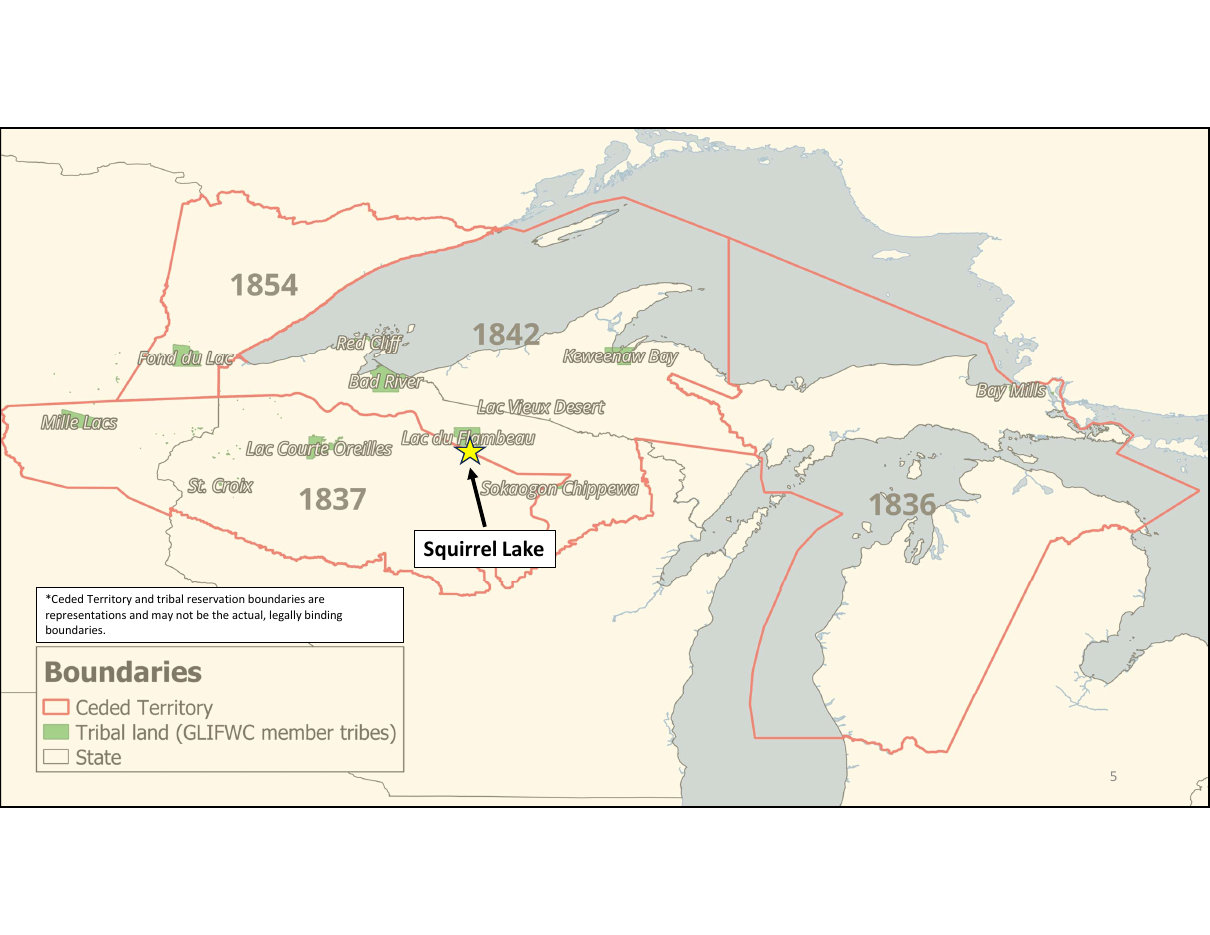
- Ceded Territory and tribal reservation boundaries are representations and may not be the actual, legally binding boundaries.
Source: GLIFWC, June 17, 2026
See also: Tribal harvest management
Surveys
- Did you know that Squirrel Lake is a Walleye Study Lake? Every two years the DNR and GLIFWC are on our lake managing the fishery. This occurs every five years for most lakes.
- The next walleye census is scheduled for 2027
Source: Walleye Special Interest Group Update, June 2026
Mark-Recapture Surveys
- Northern Wisconsin and western Upper Peninsula
- Lakes surveyed semi-annually to roughly every five years
- Long-term study lakes elucidate life histories of individual fishes
Source: GLIFWC, June 17, 2026
Recruitment and Gamefish Surveys
- Conducted each fall during a six-week period beginning the second week of September
- Target juvenile walleyes and gamefish (bass, pike, musky)
- Assess recruitment and survival of juvenile fishes
Source: GLIFWC, June 17, 2026
See also: Walleye, Musky, Bass
Report tagged fish
Report Your Tagged Fish! www.glifwc.org/report-tagged-fish
What the GLIFWC form at that address asks for:
- Tag Number
- Tag Color
- Please provide the color of the fish tag (i.e. yellow, green, etc).
- Date of Capture
- Location of Capture
- Provide the name of the waterbody and county and the nearest town.
- Species of fish (if known)
- Length/weight of fish (if known)
- Was this fish kept?
- Additional Comments
Source: GLIFWC, June 17, 2026
See also: Reporting tagged fish (User Survey)
See also: PIT Tagging & Angler Participation
Additional Resources
- https://healthylakeswi.com/
- https://www.midwestglaciallakes.org
- https://www.keepfishwet.org/walleye-in-our-hands
Source: GLIFWC, June 17, 2026
See also: www.glifwc.org, dnr.wi.gov
Resources
- · Squirrel Lake Group Meeting · Wisconsin DNR and GLIFWC
- · Squirrel Lake Walleye Special Interest Group Update · Squirrel Lake Walleye Special Interest Group
- · Tribal Harvest Management and Status of Squirrel Lake Walleye Fishery · GLIFWC
- · Musky Survey Results – 2026