Contents
| Folder | Reports |
|---|---|
| Date | |
| Source | Squirrel Lake Walleye Special Interest Group |
| Author | Bryan Haack, Squirrel Lake resident |
| Topics | Walleye, Walleye Regulation Change for 2027, Shoreline, Shoreline Habitat Education and Improvement, No Wake Buoys Protecting Prime Walleye Spawning Sites, Bass, General, Musky, Water Quality, Lake Temperature Monitor |
A few months ago, we created a walleye special interest group to research the walleye population, trends and potential options to augment the walleye fishery. We felt the walleye fishery was declining and didn’t want the population to decline to the point of no return. We now have 108 members on the Squirrel Lake Walleye Initiative Facebook group site. Our membership includes lake residents, non-residents, external lake users, a DNR fisheries biologist, a GLIFWC fisheries biologist and anyone who requested to join. This post is going to list our plan and the results for each topic.
May 14 Squirrel Lake Special Interest Group Meeting
Meeting agenda:
- Establish the special interest group – voted to create the Squirrel Lake Walleye Special Interest Group
- Establish group communication – use Facebook group site
- Create population baseline and history – Brandon Byrne GLIFWC Fisheries Biologist
- What is different about year 2019
- Research stocking – cancelled
- Research portable walleye hatchery – invite Headwater Hatchery to future meeting
- Research other walleye habitat opportunities – Nathan Lederman
- Research funding – Wayne Krantz
- Squirrel Lake walleye regulation – Nathan Lederman DNR Fisheries Biologist for Oneida County
- Co-lead volunteer – Rachel Eggebrecht
I was surprised that Nathan and Brandon both attended the kickoff meeting. So, we quickly voted to formally create the Squirrel Lake Walleye special interest group. Brandon volunteered to present the walleye population history and baseline at the next meeting. Nathan suggested we don’t pursue stocking because the results have been poor and it is a costly alternative. We decided to invite Al Luke from Headwaters Hatchery to the next meeting so we could get more educated on the portable hatchery alternative. Nathan volunteered to bring back other habitat enhancements we can make for our natural reproduction. Wayne Krantz volunteered to research grants to help fund selected projects that require investment. Nathan opened the discussion about the current walleye regulations on Squirrel Lake and the possibility of changing them. I requested a co-leader to help lead and coordinate the group and Rachel Eggebrecht volunteered.
June 17 Squirrel Lake Special Interest Group Meeting
Population baseline and history, tribal spearing, walleye regulations – Brandon and Nathan
Squirrel Lake Adult Walleye Graph
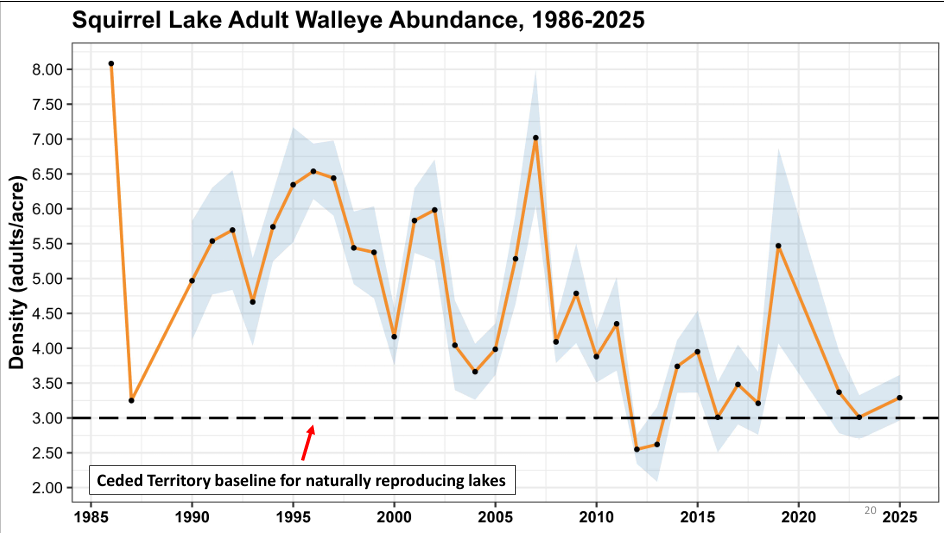
- This graph shows the decline in walleye population from 1985 to 2025
- It is normal to have swings in population from year to year
- We do not want to go below the ceded territory baseline
- The trend shows confirmation of the perception of walleye population decline.
- We also discussed the year 2019 and that variations are common.
Squirrel Lake Walleye Harvest
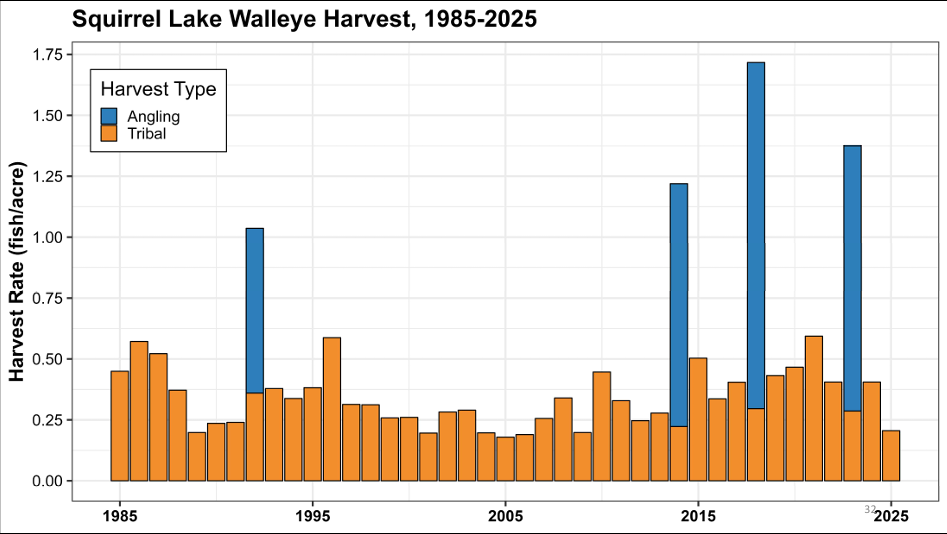
- I used the combined Angling and Tribal years of 2014, 2018 and 2023
- The Angling harvest is 82% of the total
- The Tribal harvest is 18% of the total
- We need to investigate why the Angling harvest is so high
- The next walleye census is scheduled for 2027
Ceded Territory Walleye Harvest
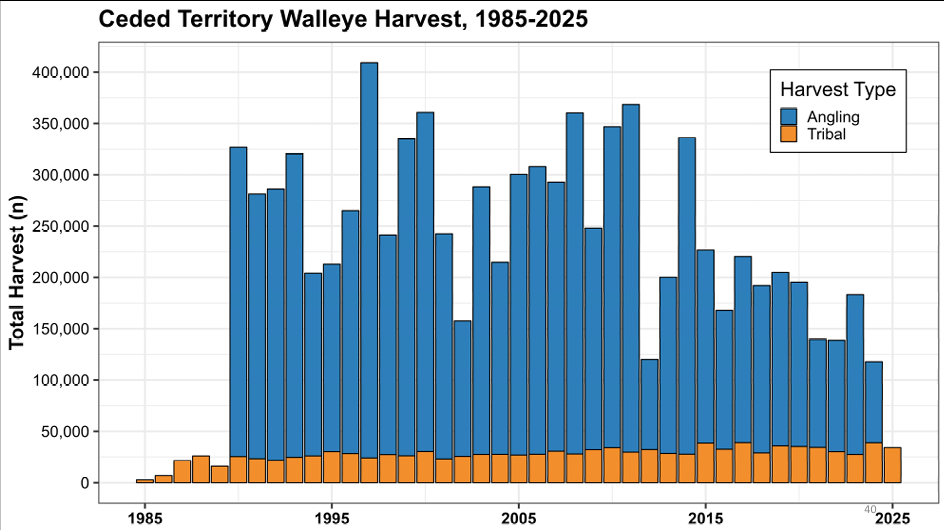
- This graph shows the entire ceded territory harvest split between tribal and angling.
- It was used as confirmation that the Squirrel Lake results look similar
Squirrel Lake Walleye Regulation Discussion
Current Squirrel Lake Hook and Line Walleye Regulation
- Maximum of 3 per day
- No minimum size
- Only 1 over 14”
The current walleye regulation is driving over harvest walleyes
The current walleye regulation encourages external lake traffic to keep small walleyes
As recommended by Nathan and Brandon, allow walleyes to spawn once before harvesting
Ceded Territory Walleye Regulation
- Maximum of 3 per day
- Slot size 15” to 20”
- Only 1 over 24”
The ceded territory walleye regulation allows more walleyes to reach reproductive length before being harvested. 90% of males mature by 13” and 90% of females mature by 18”
Below is a graph of the walleye population by length with an estimated 22% available for harvest using the Ceded Territory Regulation
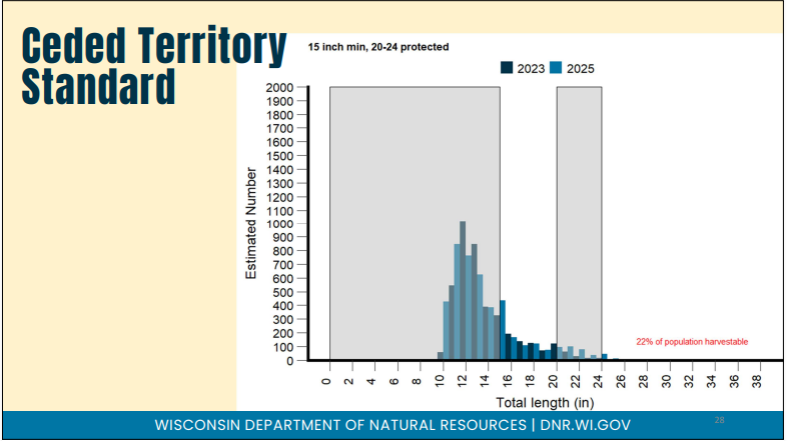
WE IDENTIFIED A PROBLEM CONTRIBUTING TO THE SQUIRREL LAKE WALLEYE POPULATION DECLINE – The current Squirrel Lake hook and line walleye regulation promotes the over harvest of young walleyes.
THE SOLUTION – Change the walleye regulation to the ceded territory standard
WE TOOK A VOTE – All were in favor of the regulation change
What is next – Nathan will create a Squirrel Lake fish survey. The survey will get posted to get feedback from the community. Nathan will progress the regulation change through the formal DNR process for approval to be implemented next year.
What else can we do to improve the walleye spawning?
- Nathan and Brandon are doing a complete shoreline assessment to identify prime walleye spawning sites
- They will come back with suggestions to improve these sites
- This happened this morning (June 25th) with two lake members assisting (Wayne Krantz and Glen Isensee)
- Nathan and Brandon may have other suggestions in the future
Portable Fish Hatchery
- Two times we tried to schedule Al Luke from Headwaters Hatchery and he cancelled both times
- The mobile hatchery is not working on the Minocqua chain. Millions of eggs have been hatched but survival has been very poor.
- The results of the mobile hatcheries are low, the expense and labor are high
- The Squirrel Lake Walleye Special Interest Group voted not to pursue the mobile hatchery at this time
There are many contributing factors to the walleye population decline (e.g. shoreline development, global warming, increased bass population, Northern Pike predation, etc., etc.). We will continue to investigate other walleye population initiatives.
Did you know: Squirrel Lake is in the top 5 naturally producing walleye lakes in Oneida County. Nathan and Brandon had many good things to say about Squirrel Lake.
Myth Number 1 – The DNR and GLIFWC are difficult to work with and are not proactive with Squirrel Lake Fish Management
This is not true. DNR Fisheries Biologist Nathan Lederman and GLIFWC Fisheries Biologist Brandon Byrne exceeded my expectations in every way. They never had a point of contact on Squirrel Lake. They both brought so much information about Squirrel Lake to our meetings for analysis. Did you know that Squirrel Lake is a Walleye Study Lake? Every two years the DNR and GLIFWC are on our lake managing the fishery. This occurs every five years for most lakes. In April, when I first contacted Nathan, he asked if I could share the Musky netting results with the Squirrel Lake community. At our first meeting, we asked about the impact bass has on the walleye population. The answer was, we only monitor walleyes and muskies. A few weeks ago, Brandon had his team shocking the shoreline to count bass. They were both professional and positive in every interaction we had. We need to keep this relationship going. From a walleye perspective, myself and Rachel Eggebrecht were the main contacts for Nathan and Brandon.
Myth Number 2 – Tribal spearing is the cause of the Squirrel Lake walleye population decline
This is not true. Tribal spearing accounts for less than 20% of the annual walleye harvest on Squirrel Lake and across the ceded territory. I had not seen this information before; the charts above show the data. For Squirrel Lake, the current walleye regulations encourage over harvesting.
Thank you to the following
Brittani Mertens: Brittani was the very first person to say we are in and how can I help. Brittani created the Squirrel Lake Walleye Initiative Facebook page
Rachel Eggebrecht: Rachel was co-coordinator, Facebook manager, technical presentation specialist, scheduled meetings, herded cats, etc., etc.
To all those that actively participated: At the last meeting, I looked around the room and saw a diverse collection of Squirrel Lakers, a DNR Biologist, a GLIFWC Biologist and a member of the Lac Du Flambeau tribe all talking about walleyes. It was the first time I have seen such a site. Never underestimate the power of the walleye.
Shh, I have a secret to share with you. Do you know where the walleyes are biting on Squirrel Lake? Right by the lip. Gotcha.
Bryan Haack
Squirrel Lake Resident